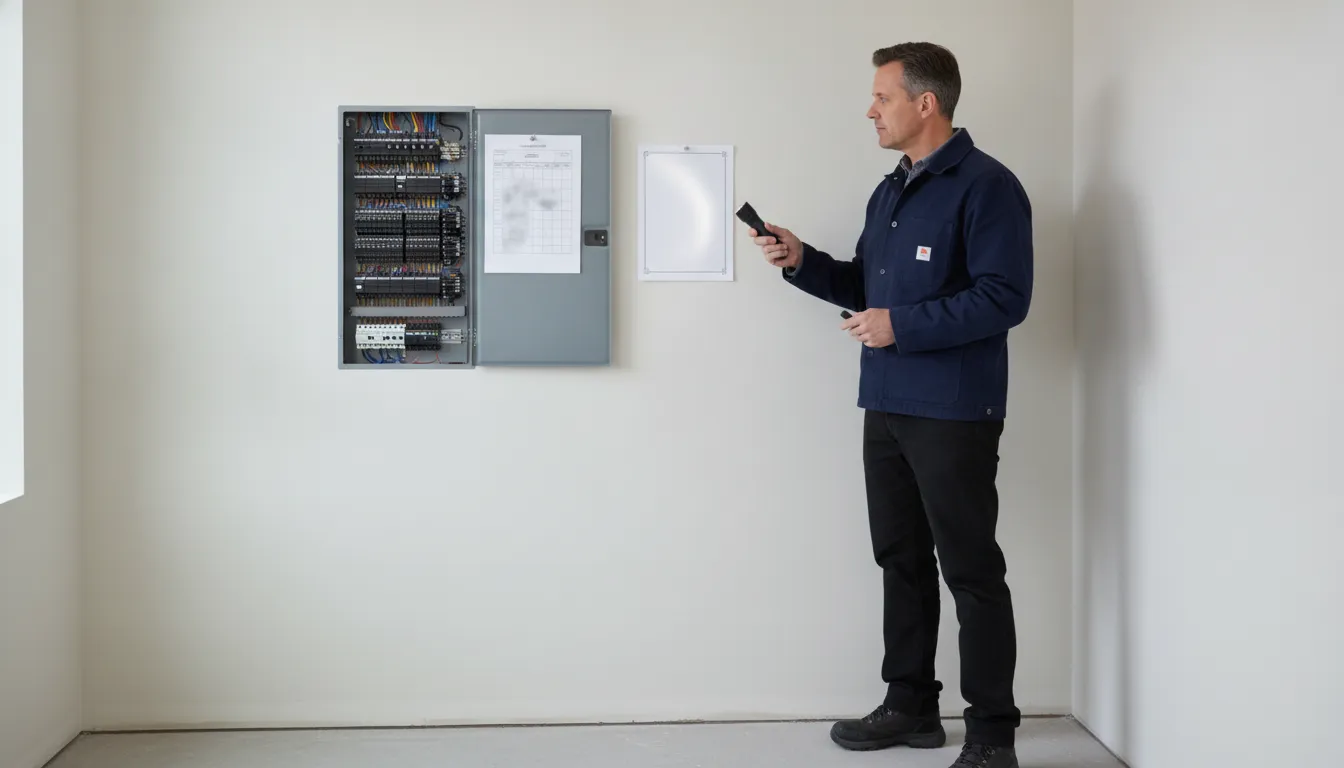
TR8 permanent certificate requirements NYC apply when a job must show that the building’s posted energy certificate matches the approved work. The certificate is a finished-building record. It is not the TR8 form, and it is not a certificate of occupancy. The builder or other approved party completes and posts it. The progress inspector then checks location, completeness, and accuracy before dating the ID2 line on the TR8.
Request a quote for the TR-8 permanent certificate inspection
Teams lose time when that certificate is treated as paperwork that can wait until sign-off week. A missing value, a covered panel label, or numbers that do not match the approved energy analysis can hold the progress-inspection certification. This guide covers what the certificate must say, where it goes, which records support it, and who does which part of the closeout.
What the TR8 Permanent Certificate Is
On the NYC Department of Buildings TR8, “Permanent certificate” is its own progress-inspection row. The form’s full name is Technical Report Statement of Responsibility for Energy Code Progress Inspections. The May 2020 form lists the row as table reference ID2. It sits apart from maintenance information (ID1) and electric vehicle service equipment (ID3). Column 3C is where the progress inspector dates the actual final inspection for that row.
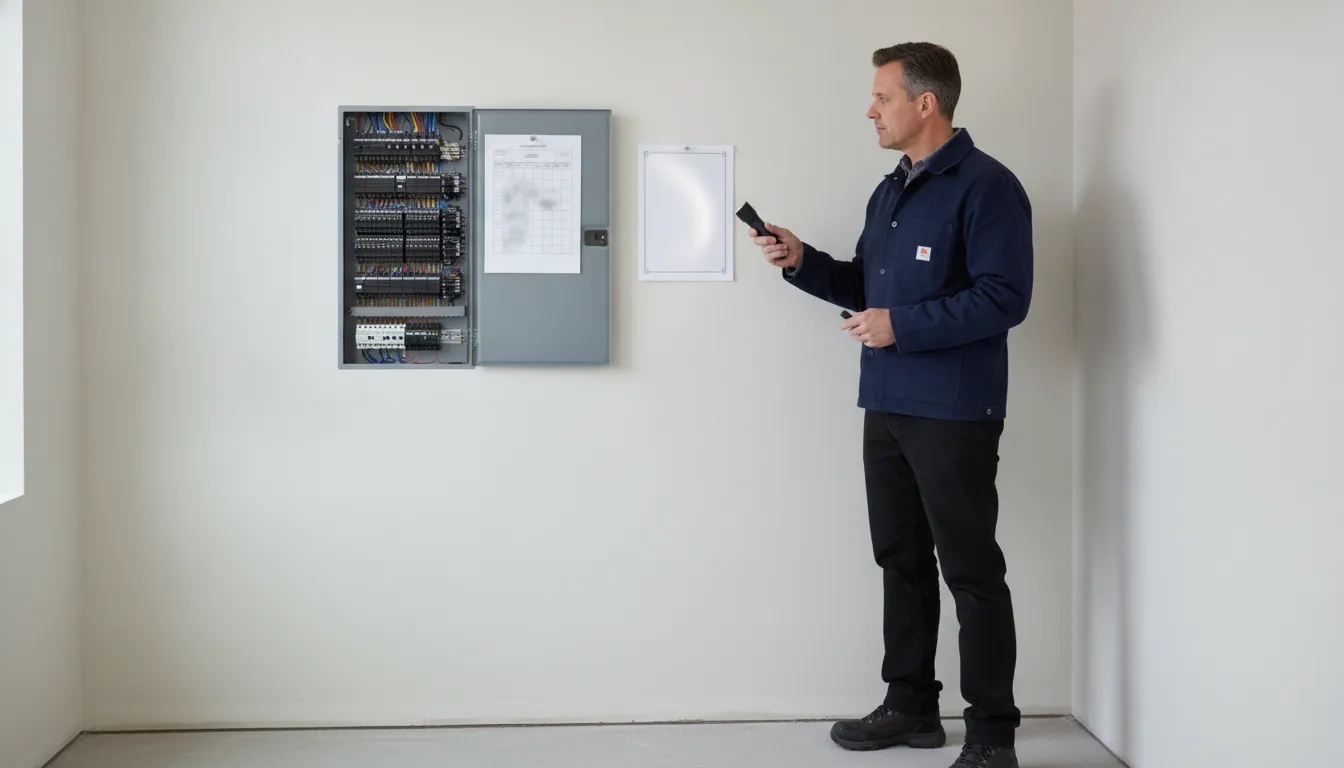
The certificate itself comes from the New York City Energy Conservation Code. For residential buildings, Section R401.3 requires a permanent certificate completed by the builder or other approved party. It is posted on a wall in the space where the furnace is located, in a utility room, or in another approved location inside the building. If it is placed on an electrical panel, it must not cover the circuit directory, the service disconnect label, or any other required label.
DOB’s supporting-documentation guide for energy-code filings states the same idea for new buildings under R401.3 or C401.3. The certificate is installed indoors. It may be posted near the electrical distribution panel, at eye level and in plain sight. The builder or other approved party completes and posts it. EZTR1’s TR-8 Permanent Certificate inspection follows the progress-inspection rule in 1 RCNY. The installed certificate is visually inspected for location, completeness, and accuracy.
That inspection is one line on a larger TR8. It does not replace envelope, mechanical, or lighting inspections, and it does not replace the design applicant’s energy analysis. The documents below do different jobs. Mixing them up is how closeout packages come back incomplete.
| Document | Who prepares it | What it proves at closeout |
|---|---|---|
| Permanent certificate | Builder or other approved party | Posted record of installed envelope values, fenestration, test results, and equipment. |
| TR8, ID2 row | Progress inspection applicant | The posted certificate was inspected for location, completeness, and accuracy. |
| EN-2 | Design professional for the approved energy analysis, with the inspection agency | As-built energy analysis when construction no longer matches the approved analysis. |
| Certificate of occupancy | Department of Buildings, after its own sign-off review | Permission to occupy, separate from this energy-code progress inspection. |
Calling the permanent certificate a “final CO” creates the wrong package. Occupancy documents depend on many filings. The ID2 inspection only certifies this energy-code item.
TR8 Permanent Certificate Requirements NYC Teams Should Check
Contents depend on the energy code that governs the application. The DOB TR8 inspections and reporting FAQ says earlier-code jobs must use the code, rule, and forms for that filing, including the TR8 version. Confirm the code year on the approved drawings before copying a certificate template from a newer job.
Under the 2020 NYCECC residential rule, R401.3, the certificate lists the predominant R-values of insulation. That includes ceilings, roofs, walls, and foundation parts such as slabs, basement walls, crawl space walls, and floors. It also lists ducts outside conditioned spaces. Fenestration U-factors and solar heat gain coefficients belong on the certificate. Where a component has more than one value, list the value that covers the largest area. Required duct-leakage and envelope air-leakage results go on it as well.
Equipment is part of the same certificate. It must show the types and efficiencies of heating, cooling, and service water-heating equipment. If the home has a gas-fired unvented room heater, an electric furnace, or a baseboard electric heater, the certificate names that equipment. It must not show an efficiency number for those three types.
DOB’s current supporting-documentation guide, written for 2025 NYCECC filings, asks for the same core data and adds items that a 2020-only template may omit. Use the edition on the permit, not a generic checklist:
- R-values for opaque assemblies, including ducts outside conditioned space.
- U-factors and SHGC for windows, doors, and other fenestration.
- Results of required duct and envelope air-leakage tests.
- Types, sizes, and efficiencies of heating, cooling, and service water-heating equipment, with the no-efficiency rule for unvented gas heaters, electric furnaces, and electric baseboard heat.
- On-site photovoltaic array capacity, inverter efficiency, panel tilt, and orientation, when those panels are installed.
- Energy Rating Index scores with and without on-site generation, when an ERI path was used.
- The code edition, the compliance path, and any additional efficiency measures used for compliance.
- The location and dimensions of a solar-ready zone, when one is provided.
Location is a requirement, not a preference. Post the certificate where the applicable section allows, keep it permanent, and keep every required panel label readable. A certificate stored in a closeout binder, or taped over the circuit directory, fails the inspection the TR8 is asking for.
Commercial jobs need a separate read of the code year. The 2020 commercial chapter points Group R-3 buildings that use the commercial path back to R401.3. Later DOB guidance also cites C401.3 for a permanent and thermal envelope certificate on new buildings. Do not assume a commercial job has no posting duty just because the TR8 row is labeled ID2.
Timing and the Records That Support Sign-Off
TR8 instructions split the form into four moments. Before approval, the design applicant marks whether each progress inspection is required. Before the permit, the progress inspector initials responsibility. Before sign-off, that inspector dates column 3C only after the inspection is complete and the work is satisfactory. Withdrawal, if it happens, is a separate column. ID2 cannot be dated as complete while the certificate is still a draft in someone’s email.
Build the certificate from the approved energy analysis, the as-built drawings, and the test reports already required by other TR8 rows. Air-barrier testing, duct leakage, fenestration ratings, and equipment submittals are the usual sources. If those inspections are not finished, the certificate is guessing.
As-built changes are a frequent stall. The TR8 FAQ says the EN-2 lets the design professional who prepared the original approved analysis submit a revised energy analysis. Construction-document changes still go through an AI-1 or a post-approval amendment. The progress inspection agency signs the EN-2 and states that the as-built documents match the field. If the inspector’s notes and the drawings disagree, the EN-2 is not ready.
Better-than-approved equipment does not always force a new analysis. The same FAQ says a revised energy analysis is not required when installed values are simply more efficient than the approved analysis. A revision is required when those better values are used in a trade-off the approved analysis did not recognize. The certificate should still describe what was installed. The TR8 inspector checks the certificate against the documents that govern the job.
Keep a closeout folder that a reviewer can follow without a meeting:
- Approved energy analysis and the drawings that identify required TR8 items.
- TR8 with the ID2 row identified, responsibility accepted, and completion dated only after the inspection.
- Photo of the posted certificate showing its location and that panel labels remain visible.
- Copy of the certificate text, including R-values, U-factors, SHGC, test results, and equipment.
- Matching fenestration labels, equipment submittals, and air-leakage or duct-leakage reports.
- EN-2, AI-1, or PAA when the as-built condition is not the originally approved analysis.
Maintenance manuals are a different TR8 row. ID1 covers maintenance information provided to the owner. Do not staple the permanent certificate into the O&M binder and call ID2 done. The certificate has to be posted in the building. The manuals have to be turned over. Both can be inspected on the same visit, but they answer different code sections.
Who Is Responsible, and Where EZTR1 Fits
The design applicant identifies the required progress inspections and states whether commissioning is required. That person is the professional engineer or registered architect responsible for the plans. The duty happens before approval. It includes marking ID2 yes or no for the specific application. A team should not discover at sign-off that the row was never identified.
The progress inspection applicant accepts responsibility before the permit and must be qualified under the Department’s approved-agency rules. Completion certification is a later act. TR8 instructions say the inspector certifies only when the inspections are finished and the related work is satisfactory. For ID2, that means the inspector has looked at the installed certificate, not at a promise that the builder will post one later.
The builder or other approved party still prepares and posts the certificate. The inspector does not become the builder by signing the TR8. If a value is wrong, the posting party corrects the certificate. If the posted values show that construction left the approved analysis, the design professional amends the energy documents. DOB’s FAQ is direct on audits. When a job is in energy-code audit for TR8 reports, the Department is reviewing the inspector’s work product. The design applicant may need to amend drawings so they reflect what the inspector found.
EZTR1 is a New York City Department of Buildings registered Class 2 special inspection agency. The firm focuses on small and medium projects. It publishes the TR-8 Permanent Certificate inspection as its own orderable item. That item is separate from other TR-8 lines such as projection factors, vestibules, and maintenance information. Ordering the inspection does not assign design responsibility, and it does not file the EN-2. Those stay with the registered design professionals named on the application.
Use the product page when the scope is only the posted-certificate inspection. Use the TR-8 energy inspections category when the job needs several energy-code progress items together. If as-built values changed, coordinate the EN-2 energy code analysis with the design professional who owns the original analysis. For how that revised analysis is filed, see the NYC EN-2 energy code analysis guide. A neighboring TR8 line, such as projection factors, has its own inspection and should not be folded into the certificate write-up.
If an energy inspection is already unsatisfactory, fix the field condition before anyone dates ID2. The failed special inspection guide explains what a failed result means for the project team. Leaving the certificate incomplete while other rows are disputed only adds a second open item at sign-off.
A Practical Closeout Sequence
Start from the approved TR8, not from a blank certificate. Confirm ID2 is marked required. Then collect the installed R-values, fenestration ratings, test results, and equipment data that the governing code section names. The posting party fills the certificate and mounts it in an allowed location without covering required labels.
The progress inspector compares the posted certificate with the approved analysis and with the field. Location, completeness, and accuracy are the three checks named on EZTR1’s ID2 scope. Only after that inspection is satisfactory should column 3C be dated. If the certificate reveals a trade-off or an as-built condition the approved analysis never showed, pause and send the design professional back to the EN-2 or amendment before certification.
Owners should leave the certificate in place after sign-off. It is the record a later contractor, auditor, or buyer uses to see how the building was insulated and equipped. Painting over it, or moving it into a storage closet, defeats the reason the code makes it permanent.
Small and mid-size jobs often combine this visit with other energy-code progress inspections. That is efficient only when each TR8 row has its own evidence. One photo of a mechanical room does not prove fenestration U-factors, duct leakage, and the posted certificate at the same time.
Call (646) 396-1924 to schedule the ID2 inspection
Frequently Asked Questions
Is the permanent certificate the same as a certificate of occupancy?
No. The permanent certificate is the energy-code posting required by the code section that applies to the filing, and ID2 is the TR8 progress inspection of that posting. A certificate of occupancy is a separate Department of Buildings approval. You can have a correct energy certificate and still be waiting on other sign-off items.
Who fills out the permanent certificate?
The builder or other approved party completes and posts it. The progress inspector does not replace that role. The inspector checks the installed certificate for location, completeness, and accuracy, then certifies the ID2 row when the result is satisfactory.
What if the certificate is on the electrical panel?
The code allows an approved location that may include the electrical panel, and DOB guidance allows posting near the electrical distribution panel at eye level and in plain sight. The certificate must not cover the circuit directory, the service disconnect label, or other required labels.
Can we date the TR8 if the certificate is ready but not posted?
No. TR8 instructions call for the completion date when the required inspection has been performed and the work is satisfactory. A certificate that is still in a folder has not been inspected in its installed location.
Which energy code edition should the certificate follow?
Use the code, rule, and TR8 that apply to the application. DOB’s TR8 FAQ points teams to “What Applies When” for earlier codes. A 2025 filing asks for more certificate entries than the 2020 residential section, including code edition, compliance path, and certain solar and ERI items when they apply.
Schedule the ID2 Inspection
If the drawings already mark a permanent certificate, put the posting and the ID2 inspection on the same closeout list as the EN-2 and the other TR8 rows. EZTR1 can inspect the installed certificate for location, completeness, and accuracy on small and medium New York City projects. Call (646) 396-1924 or request a quote and have the job number and the required TR8 rows ready.
Leave a Reply